

Derivative Reform and Brave New Platforms

Friday, October 2nd, 2015

Derivatives and Regulation

Derivatives can be utilized as a key tool to protect against risks that are inherent to business. Derivatives allow financial institutions to hedge their exposure to credit risk, which helps them expand their lending and investment capabilities, fostering economic growth.

Examples of derivatives which are subject to new regulation under Title VII of the Dodd-Frank Act include interest rate, credit default and equity swaps, to name a few. Dodd-Frank’s Title VII mandates regulators, including the Commodity Futures Trading Commission (CFTC) and the Securities and Exchange Commission (SEC), to undertake rulemakings designed to meet G20 objectives of increasing transparency and reducing systemic risk in the derivative markets, including:

  • Reporting swap transactions to a swap data repository;
  • Clearing sufficiently liquid and standardized swaps on central counterparties;
  • Where appropriate, trading standardized swaps on trading platforms; and
  • Setting higher capital and minimum margin requirements for uncleared swaps.
  • The CFTC has completed most of its Title VII mandated rulemakings, establishing a regime of regulatory oversight for many new entities, including swap intermediaries known as “Swap Dealers” and “Major Swap Participants” (MSPs), as wells as clearing houses and trading platforms.

    Under this new regime, sufficiently liquid and standardized derivatives transactions are required to be centrally cleared, and the most liquid of those are required to be executed on platforms.

    Clearing Platform and Integration

    Markit’s Trade Manager offers buy-side participants a single platform for addressing electronic confirmation, clearing and electronically ineligible (‘paper’) trades. Buy-side firms can submit trades and track updates in real-time. Customers can upload trades in Excel format or via the Client API in a real-time FpML API. Our client, utilizing CRD, wanted to send SEF executed IRS and OIS trades to Trade manager.

    Swap Execution Facility (SEF) is a platform for swap trading regulated by the Securities and Exchange Commission and the Commodity Futures Trading Commission that provides pre-trade information (bids and offers) and an execution mechanism for swap transactions among eligible participants. These transactions are usually sent to the LCH (London Clearing House) or CME (CME Group) for clearing.

    There is a challenge when implementing Trade Manager with CRD. Charles River has an interface with Trade Manager; however, the interface was created as a back office function. To support straight through processing, the challenge is to have trades match and clear in Trade Manager before sending it to the back office.

    The standard CRD interface was leveraged and customized to send the trade to Trade Manager once the trade is completely executed, prior to sending to the back office. This interface created an Excel CSV file that was sent via SFTP and automatically injected into Trade Manager. The status’ from Trade Manager are sent to CRD every 15 minutes (not real-time) and are visible on the trade blotter. Once the trade has reached ‘cleared’ status, the trade is automatically sent to accounting. You can see real-time status’ utilizing Trade Manager accessed via a web browser.

    Because of CRDs incredible flexibility we were able to leverage and customize the existing interface to accomplished clearing the trade prior to it being delivered to the back office. This eliminated the need for cancel and corrections due to unmatched trades, cutting down on cost and creating a straight through process for SEF executed IRS and OIS trades.
Performance Attribution for Asset Managers

Wednesday, April 15th, 2015

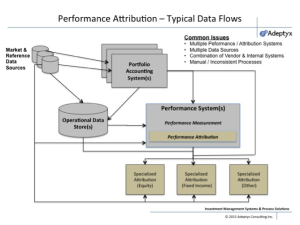
Performance attribution allows asset managers to provide timely feedback on the investment process, internally and externally. In the past few years, firms have met challenges to meet industry standards in evaluating sources of returns for transparency and disclosure in performance and attribution measurement. Adeptyx Consulting is helping our clients to be better positioned for growth, and getting there through leveraging automation as a modern approach to more effective data management.

More and more, firms are diversifying across asset classes. This significantly increases the complexity of performance measurement and attribution, and many firms are struggling with inflexible infrastructures that do not support their growth.

There are a lot of available products and options for firms who want to evolve their performance attribution models, and who are looking to balance customization and flexibility, with quicker implementations and lower costs. Solutions include exploiting existing features of in-house portfolio management systems, choosing to build or integrate purchased software, or signing on for cloud or hosted solutions. Decisions to build, buy or develop a hybrid approach are situational dependent, and the pros and cons of each approach must be considered.

A disciplined approach to projects and a rigorous examination of a firm’s requirements is needed to seek out the beChartst solution.

Priorities for today’s business include:

  • Seamless integration with existing systems;
  • Support for changing business functions;
  • Normalizing data inputs from multiple sources;
  • Ensuring consistent data across systems;
  • Maximizing the value added for costly market data;
  • Minimizing project costs and the time to implement;
  • Customizing solutions when necessary;
  • Automation of data collection, and calculation;
  • Reporting of results internally and externally;
  • Ability to scale systems for increased volumes and products.

A good initial step in the process of evolving your performance attribution system is to understand what solutions are available in the market place. Adeptyx Consulting has done comparisons of featured systems and can provide insights into our findings upon request. Please send inquiries to: AriFuad@adeptyx.com.

Case Study – Operational Excellence

Friday, April 25th, 2014

Operational Excellence Strategic Review

The Problem:

A Wealth Management/Family Office firm had rapidly increased in size, operating complexity, and maturity.  Due to this growth, the firm was concerned it wasn’t operating at maximum efficiency.  Also, the firm wanted to be properly positioned to support expected future growth. The company was at an inflection point, and wanted to engage a third-party consulting organization to undertake a strategic review of their operation.

What We Did:

  • Started by conducting interviews with management and staff to understand ‘current state’ job functions and business processes.
  • Documented current state job descriptions, process/data flows, and operating model/functions.
  • Facilitated joint sessions to derive a ‘future state’ operating model – identifying where functional re-alignment was required.
  • Created future state job descriptions to align with the newly proposed operating model.
  • Held joint sessions to analyze the current state process flows, and identified several business process improvement (BPI) opportunities.
  • Finished by documenting a series of recommendations- including both process improvement and automation opportunities to increase efficiencies and reduce operating risk.

Scope of our work covered the following functions:  Operations, Client Service, Investment Analysis, Partnership Management, Compliance, Human Resources, and Administrative Support.

The Results:

The wealth manager was provided an improved organizational structure, which allows them to more efficiently scale the business with better alignment of job functions. We identified several new roles, shifted job functions to lower cost resources, and better aligned tasks with staff skillsets.  Additionally, Adeptyx offered several operating model recommendations to improve project delivery and on-going change management initiatives.

The company also was provided a prioritized list of BPI recommendations that will help streamline processes, increase automation of manual tasks, and reduce risk.

Getting Vendor Applications to Actually Work

Thursday, August 16th, 2012

Have you been seduced by technology? Imagine sitting in a conference room
listening to a vendor expound on the amazing capabilities of their products, then,
taking the plunge and integrating this amazing software into your workflows. The
vendor sends out an integration specialist (at your expense) to help implement said
software. Everything is going wonderfully. Then, the specialist moves on to his next
project, only to leave you with software that doesn’t quite live up to its conference
room presentation.

Vendor presentations are created to show the capabilities of their products.
Therefore, they are crafted and designed with precise parameters. Carefully
rehearsed so there are no rough edges. Wouldn’t it be great if there were no rough
edges in the real world?

Adeptyx Consultants can help smooth the rough edges. We take an objective view
of your workflow and of the vendor solutions. Applying industry best practices,
we construct workflows that work for your business utilizing the capabilities of
software.

Adeptyx was recently engaged to help a company with their trading system
workflows. The root of the problem, we discovered, was from the suite of back
office products. Data was incorrect. Corporate Actions were being missed.
Reconciliation was an arduous process (much more than usual). Dividends were
posting incorrectly or not at all. They were bleeding. While the engaged consultant
had never worked with this vendor’s products, he rolled up his sleeves and jumped
in.

We started with corporate actions. For over a year the “automated” process
had been inoperative. The company had come to rely on custodian data for
Corporate Actions and dividends. We rebuilt the process from the ground up and
successfully “integrated” Corporate Action Notification. Now that we had data
flowing in this enabled the back office to post on ex-date with the ability to adjust
the data, if necessary, prior to pay-date.

Reconciliation is often an arduous process. The vendor’s products offered a solution
to reconcile positions, and if necessary, transactions. A very capable suite of tools
on the surface. However, the solution implemented was solely a transaction-based
reconciliation. In addition, the system wasn’t exception processing. Matches were
manually approved, near matches were manually approved (making the cash
position incorrect), and mismatches were investigated. Dividend accruals were
also an issue. Some banks accrued, while others did not. This made the month end
reconciliation very problematic.

We discovered a report that allowed for exception based position reconciliation.
Not only did it allow reconciliation of the cash position daily, it would compensate
for any buys or sells posted in the accounting system trade date-2 against the
custodian’s position. In terms of positions, some banks supply Trade date positions,
some supply Settle date positions. To complicate matters, some large banks deliver
Trade date positions, but Settle date cash. Working with the vendor we learned
of a beta report that would allow reconciliation of trade date positions and settle
date cash. It also allowed us to either include dividend accruals or not at an account
level. Utilizing this report, we executed an exception-based workflow that not only
saved valuable time and resources, but also now delivers correct position data to the
trading system.

Compliance is a trader’s enemy. Data is key to compliance violations. Now
that we had correct data flowing to the trading system, it was time to unravel
the compliance puzzle. During the implementation of the trading system, the
compliance department was informed that the trading system could not perform
basic compliance validation. To deal with this limitation, adaptations were created
outside of the vendor system using Excel. With the compliance department’s
consent, we decided to look at fixing the compliance rules in the trading system
as an initial implementation. The contracts and mandates were examined for all
compliance violations and they were organized so as not to create duplicate rules
in the trading system. In starting the process from the beginning, we were able to
automate 99% of the compliance rules in the trading system. This enabled us to
eliminate the need for Excel spreadsheets. The new process not only saved valuable
time and resources, it also allowed the traders to execute trades without invalid
compliance violations.

By correcting the data at its source, and re-implementing compliance into the
trading system, the rough edges of the trading system started to smooth out. The
ghosts plaguing the system were gone, not by adjusting the trading system as
originally thought, but by correcting the underlying problems. The approach to look
at the entire process not only rectified the trader’s workflows; it saved time and
resources in the Back Office and Compliance departments. By taking a holistic view
of the entire process we were able to build a solution that works utilizing the chosen
vendor packages.

Recent Posts


Categories