January 2017 Update – New Hire News
January 27th, 2017
|
|||||||||||||||||||||||||||||||||||||||||||||||||||||||||||||||||||||||||||||||||||||||


January 2017 Update – New Hire NewsJanuary 27th, 2017
Derivative Reform and Brave New PlatformsOctober 2nd, 2015 Derivatives and Regulation Examples of derivatives which are subject to new regulation under Title VII of the Dodd-Frank Act include interest rate, credit default and equity swaps, to name a few. Dodd-Frank’s Title VII mandates regulators, including the Commodity Futures Trading Commission (CFTC) and the Securities and Exchange Commission (SEC), to undertake rulemakings designed to meet G20 objectives of increasing transparency and reducing systemic risk in the derivative markets, including:
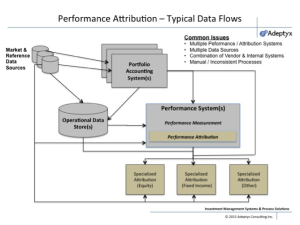
Performance Attribution for Asset ManagersApril 15th, 2015 Performance attribution allows asset managers to provide timely feedback on the investment process, internally and externally. In the past few years, firms have met challenges to meet industry standards in evaluating sources of returns for transparency and disclosure in performance and attribution measurement. Adeptyx Consulting is helping our clients to be better positioned for growth, and getting there through leveraging automation as a modern approach to more effective data management. More and more, firms are diversifying across asset classes. This significantly increases the complexity of performance measurement and attribution, and many firms are struggling with inflexible infrastructures that do not support their growth. There are a lot of available products and options for firms who want to evolve their performance attribution models, and who are looking to balance customization and flexibility, with quicker implementations and lower costs. Solutions include exploiting existing features of in-house portfolio management systems, choosing to build or integrate purchased software, or signing on for cloud or hosted solutions. Decisions to build, buy or develop a hybrid approach are situational dependent, and the pros and cons of each approach must be considered. A disciplined approach to projects and a rigorous examination of a firm’s requirements is needed to seek out the be Priorities for today’s business include:
A good initial step in the process of evolving your performance attribution system is to understand what solutions are available in the market place. Adeptyx Consulting has done comparisons of featured systems and can provide insights into our findings upon request. Please send inquiries to: AriFuad@adeptyx.com. Case Study – Client Reporting StrategyJanuary 13th, 2015 Client Challenge and Objective: A large Global Asset Manager’s (AM) client reporting process was no longer meeting the needs of their growing organization. Additionally, the AM desired a more robust, scalable, and automated client reporting solution. A temporary tactical solution was applied internally, the AM engaged a 3rd party consulting firm to undertake a strategic assessment of their existing client reporting architecture and processes. The primary objective was to identify a ‘best of breed’ client reporting solution, covering ‘end to end’ functions such as data sourcing / transformation / storing, workflow, flexibility to produce client specific formats, automation of commentary process, report assembly / production, and publishing capabilities. For a ‘Buy’ alternative, a list of preferred client reporting vendors would be provided, with their relevant strengths and weaknesses.
What We Did: Adeptyx consultants started by interviewing stakeholders involved in the client reporting process to gain an understanding of current and future state requirements. We subsequently interviewed and assessed leading client reporting vendors for potential fit with the client’s requirements. Adeptyx also utilized its deep industry network to gain current and relevant feedback on the leading client reporting systems. We then designed a high level ‘future state’ architecture, which identified the need for a Client Reporting (CR) Data Mart. As the client had a large number of independent data sources, we recommended that an initial emphasis on improved data consolidation was critical. This consolidation would greatly facilitate any package implementation and also provide other ancillary reporting advantages. The scope of the solution included the production of client reports, meeting and pitch books, RFP’s, fund factsheets, and ad-hoc report requests.
Results: Adeptyx provided the AM with a proposed ‘future state’ client reporting architecture, depicting both ‘Build’ and ‘Buy’ components. The AM was also given a list of vendors (with rankings) that best fit their client reporting requirements. Our analysis included strengths and weaknesses for each vendor along with a justification summary for the top three vendors. The AM was well positioned to issue a formal RFP to the top 2-3 vendors and conduct a deeper assessment of each vendor based on their specific reporting requirements. Additionally, Adeptyx provided the AM with a proposed future-state staffing model (both project and organizational based), and a list of prioritized next steps to successfully advance the client reporting architecture. Margining TBA’s – The Issue for Asset ManagersOctober 16th, 2014 How to reduce risk by implementing margining agreements Given the enormity of the forward settling MBS market ($750B – $1.5T), the Treasury Markets Practice Group (TMPG) recommends an exchange of two-way variation margin to mitigate the risks associated with unmargined agency MBS transactions. Participating asset managers of all sizes are taking heed and working to implement margining agreements to reduce risk and meet client and counterparty expectations. The challenge for asset managers is weighing the benefits (risk mitigation, client and counterparty expectations) against the impact to operations and on legal resources. A number of managers are already margining other securities and merely levering their collateral management processes. However, many asset managers are not moving toward voluntary compliance. Managers who do not develop the infrastructure to support TBA margining may be unable to meet investment mandates, or restricted to a less favorable asset mix- resulting in unintended negative outcomes. While many managers and dealers continue to trade without the benefit of bi-lateral margining, there’s increasing momentum toward complying with the TMPG’s best practices guidelines. Dealers are feeling increased pressure to sign MSFTA’s (Master Securities Forward Transaction Agreement) with counterparties due to the proposed amendments to FINRA Rule 4210. The amendment echoes the TMPG recommendation, but goes further to include requirements for maintenance margin and other changes which could re-open negotiations with their counterparties. Given FINRA’s proposed amendments and resultant comment period, a large number of asset managers are pausing on renegotiating the MSFTA’s until the rules are finalized. Once in place, managers and dealers will need to pick up the ball, negotiate agreements and implement margining. Why Compliance Is Worth the Effort With the trend toward increasing regulations and an appetite for finding ways to stabilize markets, asset managers may want to consider margining to limit their counterparty risk and prepare for what may be mandatory in the near future. Additionally, asset managers with systems and operations that currently support other marginable products (e.g., OTC Derivatives) may not find adding TBA’s overly onerous. Asset managers should weigh the costs of either outsourcing collateral management or converting systems/operational processes against the actual potential for loss in their overall risk profiles. Until dealers start demanding that all of their counterparties agree to margining, there may not be strong incentives for some asset managers to do so. Yet, by complying early on, managers would not be caught in a rush to negotiate terms with dealers, nor be faced with the pressure of regulatory driven projects that may impact a substantial number of client portfolios. Lastly, it will be interesting to see if there is any impact to MBS markets should asset managers decide to use other security types to meet investment management mandates. Another consideration is how clients may react to dealer demands for additional information to satisfy credit requirements and the potential for increased costs due to operational and legal requirements. What Are Asset Managers Doing? Some managers who maintain a relative high exposure to forward-settling agency MBS are substantially complying or working toward implementing margining with their larger dealers, albeit pausing given FINRA’s amendments are in flux. Most managers have yet to take action given their MBS exposure and risk versus benefit assessment. Each manager must evaluate their current and anticipated investment strategies, risk tolerance, client views, regulatory trends, and the state of their operational preparedness before deciding which path to take. Where to Start? Assess your current and anticipated future exposure to: Assess your firm’s risk profile, client and dealer expectations, and risk mitigation value versus cost and impact Assess your systems and operational capabilities to support margining, including: Assess your ability to support legal documentation, including impact to legal team and volume of agreements with dealers How Adeptyx Can Help Adeptyx has a seasoned team of professionals who have extensive experience helping clients navigate their most complex operational and system challenges. Our senior project managers have direct experience with assessing and implementing collateral management tools and the TMPG’s recommendations for forward-settling agency MBS. We can: The regulatory environment continues to trend toward tighter controls and closer scrutiny to protect investors. TBA margining helps reduce systemic risk and, arguably, improves market liquidity. Therefore, asset managers should anticipate that TBA margining will become mandatory and prepare accordingly on their terms. Adeptyx possesses the industry expertise to help you develop your strategy and implement the right solution. Contact us to learn more and how we may be of service. Adeptyx April 2014 UpdateMay 18th, 2014
Adeptyx Consulting Two-page Overview PDFApril 28th, 2014 The link below opens a 2 page PDF that summarizes our expertise and services and is an easy way to get a quick overview of our business. Case Study – Operational ExcellenceApril 25th, 2014 Operational Excellence Strategic ReviewThe Problem:A Wealth Management/Family Office firm had rapidly increased in size, operating complexity, and maturity. Due to this growth, the firm was concerned it wasn’t operating at maximum efficiency. Also, the firm wanted to be properly positioned to support expected future growth. The company was at an inflection point, and wanted to engage a third-party consulting organization to undertake a strategic review of their operation. What We Did:
Scope of our work covered the following functions: Operations, Client Service, Investment Analysis, Partnership Management, Compliance, Human Resources, and Administrative Support. The Results:The wealth manager was provided an improved organizational structure, which allows them to more efficiently scale the business with better alignment of job functions. We identified several new roles, shifted job functions to lower cost resources, and better aligned tasks with staff skillsets. Additionally, Adeptyx offered several operating model recommendations to improve project delivery and on-going change management initiatives. The company also was provided a prioritized list of BPI recommendations that will help streamline processes, increase automation of manual tasks, and reduce risk. Getting the most out of your Charles River IMS InvestmentApril 17th, 2014 Adeptyx has a robust and experienced Charles River Consulting practice. Our consultants have worked with Charles River Development (CRD) software since the early 2000s. We have been involved in a number of Charles River Investment Management System (CRIMS) installs, upgrades, and tunings, underscoring our proficiency with v8, v9 and v8 to v9 upgrades. The first Adeptyx v9 project went live in September 2010 and since then we have performed or participated on several successful projects. Charles River Investment Management System (IMS) software is complex. The software is highly configurable to deliver customized workflows with the goal of improving operational efficiency across the investment process. However many firms fall short of this goal. Reasons for this shortfall vary, but typically fall into one of 3 categories:
What are some benefits and challenges of moving to Charles River IMS v9? Here are some key benefits, features and challenges likely to be encountered and evaluated during most upgrade projects. 1) Significant performance improvements over earlier versions. On our projects we have seen improved performance around FIX, order imports, as well as core application performance due to architecture changes. 2) In v9 the application can contain many blotter views. The views are managed through user profiles. One key project issue is how clients should approach blotter profiles. Questions to be answered include: Should a template user be created? Does it make sense for application users to share profiles or have individual profiles? Do you allow end users to make updates or only have read-only access to their profiles? 3) CRD has redesigned the privilege model for v9, allowing for more flexibility. However this flexibility also requires the implementation team to make decisions on how to best use the user administration and group administration windows to implement the preferred privilege model. Our recommended approach is to define / establish business groups, and assign privileges at the group level. 4) Clients need to determine how best to take advantage of new functionality. To do this, clients should review and eliminate custom processes implemented in prior versions such as custom stored procedures and custom triggers. Also, investigate if outside applications, spreadsheets and manual procedures can be replaced. 5) Identify opportunities to make blotters and workflow rules event driven. The goal is to convert most queries to run real time, thus providing better information to the end users. 6) Several compliance enhancements were introduced in v9 that should be examined and discussed to assess the usefulness and applicability to the current workflows. These include useful features like in-trade compliance, four-eyes test authorization, validate test, ‘as of’ compliance, and substantial shareholder disclosure rules. 7) Charles River v9 was greatly enhanced over v8, and therefore a full review of all v8 workflows is needed. Obstacles will be encountered and end users will be required to change some of their workflows to gain efficiencies when moving to the latest version. To lessen the user impact, involve key end users early in the project. 8) Futures spread-trading has been introduced into the v9.1 application series. 9) Most clients run Charles River v9 on Windows 7. Therefore, your upgrade project might need to plan out how the Win7 machine rollout will occur inside their organization. 10) Clients encounter bugs in every CRIMS release. To reduce the impact of these bugs, plan and perform testing throughout the project on key user functionality and workflows. Depending on the severity and the availability of a workaround, there might be a need to push CRD to include certain fixes in the next dot release. Adeptyx consultants are knowledgeable about known application issues that could impact your workflows and can suggest potential workarounds. The Adeptyx Advantage: Adeptyx has extensive experience with CRIMS and we know what works. We know that every firm is different and that one approach doesn’t fit all. We take the time to really learn and understand your identity, your focus, your current direction, and then assist you. This is how we partner. Because of all these reasons, we help you maximize the value proposition of the your Charles River application. Here are some of the key benefits that Adeptyx will bring to the table in a v8 to v9 upgrade project. 1) Insight into industry best practices. Our consultants have seen what works and what does not work at multiple clients. In addition, our consultants have Charles River IMS experience as well as significant industry experience performing non-CRIMS projects. 2) We partner with clients to ensure our projects are successful and help create realistic project plans. In addition, we team with key project stakeholders like Portfolio Management, Trading, Compliance, Operations and IT. Our consultants are often embedded with end users to truly understand their pain points, application shortcomings and wish lists items. During our projects we often make v8 production tweaks to resolve existing issues. On all of our implementations, we focus on end user value and satisfaction. 3) Adeptyx will ensure that you benefit from new features and application enhancements. 4) We understand data and how poor or missing data will impact application functionality. 5) Adeptyx consultants have their own CRIMS implementation toolkit. Our best practice toolkit covers everything from configurations and workflow design to change tracking, migration planning and queries that can speed up projects. Our consultants will ensure unbiased implementation guidance and upon project completion our consultants will leave you with documentation and configurations that will position you for future upgrades. 6) We have also compiled a number of tips and tricks on CRIMS upgrades and usage that help us more quickly diagnose and solve existing problems. Here are some key reasons why clients engage Adeptyx consultants on Charles River IMS projects instead of just using Charles River Development (CRD) consulting services resources.
Clients find that Adeptyx offers a clear alternative to vendor resources, and the repeat business from our clients demonstrates this. Our specialty is helping clients to attain improved operations, reduce risk, and strive for efficient process governance. That is why asset management firms turn to Adeptyx for end-to-end consulting with the goal of better leveraging their software solutions. We get you to a better spot, and leave you better prepared to support Charles River Investment Management System in the future. Our knowledge is your advantage. Let us help you grow. Adeptyx October 2013 UpdateOctober 30th, 2013
|
Recent Posts
Categories
|
|||||||||||||||||||||||||||||||||||||||||||||||||||||||||||||||||||||||||||||||||||||||||||||||||||||||||||||||||||||||||||||||||||||||||||||||||||||||||||||||||||||||||||


 st solution.


 Sal Auditore is a senior Adeptyx consultant with extensive experience in advising investment firms on SimCorp Dimension’s investment management software solutions. He recently agreed to share his experiences and lessons learned given his involvement in numerous engagements.